A diachronic order can be followed using the links on the right, or the links below.
Friday, April 18, 2014
Overview and Layout
A visual presentation: Timeline in Pictures
A diachronic order can be followed using the links on the right, or the links below.
A diachronic order can be followed using the links on the right, or the links below.

Wednesday, April 16, 2014
Introduction: Historical Perspective
The world that we live in has become heavily reliant on video recording technology. In one sense, we rely on videos as consumers. We Facebook, Youtube, watch 3-D movies at the theatres and tune in to TV programmes made all over the world. We are entertained and make sense of the world in so many ways through different types of video. But in another sense, we also rely on videos as producers. Some capture our happiest moments on our phones to share them with others, or simply for keepsake, while others capture the darkest moments of humanity to evoke moral outrage, or simply to tell a story.
 |
| Wide diversity of film genres |
As consumers and producers, people have both shaped and been shaped by videos, in highly interactive ways. Consumers interpret and attempt to make sense of what they see, while producers create and attempt to make something meaningful. In this interactive process, both are influenced and influence changes in the technology underlying video: its recording and editing. Video recording and editing technology in its current form today, was therefore not the inevitable outcome of a march towards more and more advanced computers; people might have been perfectly happy with still images, or just plain text. Neither was it result of the sheer will and desire of a mankind that simply had to have their 1080p HD cat videos; people might have sought out some other form of entertainment if the technology had not made video so appealing. Instead, the history of video recording technology should be understood as a non-linear movement towards different forms, differentiated not solely by their scientific or ontological properties, but also by the different ways in which they are used by producers and consumers to create and interpret meaning.
This report considers these issues as it examines the technology behind videos--which more broadly speaking, includes all kinds of motion pictures and films--as it makes major shifts from the early forms of moving images, to film, to the magnetic tape, and finally to the digital medium. This report also looks at two recurring themes throughout this history: the popularization and miniaturization of recording tools and attempts to create impressive spectacles through stereoscopy, or 3-D.


Precursors of Motion Pictures
 |
One of Myubridge's earliest motion studies, 1878
|
The most fundamental principle underlying motion pictures is the "persistence of vision." It is produced by flashing a rapid succession of still images, As the brain is bombarded with more information than it can process, it melds discrete images together, creating the illusion of motion. (See right)
Early motion pictures
Lucretius had discovered such an idea as early as 98-55 B.C.E, but knowledge about such optical phenomena was not widely shared among ordinary people until the early modern era when the Jesuits began to investigate the universe using natural magic and then used optical devices such as peepshow boxes and magic lanterns to impress and gain status.
 Magic lanterns
Introduced in the late 17th century, magic lanterns remained a highly popular form of visual entertainment in Europe until the 19th century. Images would be projected on a screen from a magic lantern device (see right) using slides, which could be moved around to create the perception of a moving person or object. A popular magic lantern presentation was the Phantasmagoria, by a Belgian, Etienne Gaspar Robert (1763-1837). He created lifelike motion in prodigies, monsters, ghosts and skeletons, in a kind of early horror show. (See below)
Motion toys
Motion toys which could be enjoyed privately in the home also became increasingly popular in the 19th century. Initially invented for investigative purposes, these toys with high-sounding names were subsequently marketed as fashionable toys for popular entertainment. Many of these toys, such as the Phenakistoscope and the Zoetrope presented a short narrative sequence which could be looped endlessly. (See below)
Significance
The diversity of early forms of motion pictures, their different audiences, and different ways of constructing complex narratives, suggests that there are multiple trajectories in the history of motion pictures, and challenges the assumption that pictures only began moving after the introduction of celluloid film. Early cinema was not the result of a sudden technological breakthrough for the understanding of the "persistence of vision," and its application through the use of motion toys preceded celluloid film. Neither was it the result of a cultural shift that created a sudden demand for moving pictures, as the popularity of magic lanterns in Europe demonstrates. Therefore, although these precursors may not be the direct antecedents of celluloid film, they constitute an important component of the history of video recording; for they serve the same function of constructing narratives that fascinate and entertain people in the fundamentally similar way of bringing static images to life. The move from colour, in magic lanterns and motion toys, to black-and-white in film, also forces us to question whether the history of video recording technology is a linear one.
Film
Preconditions of film recording
In the late 19th century, various recording devices were concurrently invented in France, England, Germany and the United States, suggesting that there was no one source, but the combination of multiple sources. (see table below, click to expand)

Creatively using film
Remarkably, limitations in the film medium, and film recording technology prevent people from using it in a wide variety of ways. Even before the introduction of colour on film, film had been used for entertainment and propaganda; and was manipulated with special effects and even with attempts to introduce 3D.
A sterling example of film propaganda can be found in World War II, when Frank Capra produced and directed a series of documentary films to boost the American war effort. (See below)
Georges Méliès pioneered many special effects in film that became frequently used in cinema for a long time until the digital era. With double exposures, mattes, reverse motion, cutting in the camera and many other techniques, Méliès demonstrated the near limitless potential of film. (See below)
Using two interlocked cameras, Natural Vision attempted to introduce 3-D films in the 1950s. Despite the initial enthusiastic response, the eyestrain caused by these films eventually led to general disinterest. This was perhaps one of the limitations of films that could only be overcome by an improvement in the recording and projection technology. (See below)
In order to record motion pictures, a few preconditions had to be satisfied.
1) There had to be some way to create the illusion of movement. The "persistence of vision" had been discovered since the 1st century B.C.E and optical toys enabled scientists to explore the concept further.
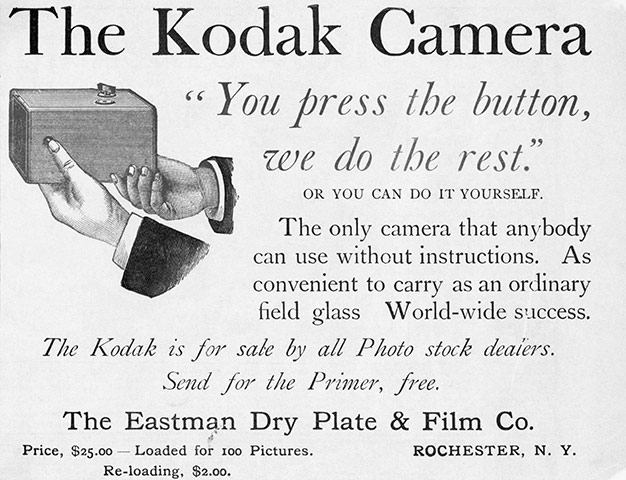 |
| Eastman's Kodak camera was designed for unskilled amateurs. |
2) A medium superior to glass or metals was needed. It took several minutes for photographs to be imprinted on glass or metals, but the exposure time needed to be drastically reduced for multiple frames to be recorded in one second. Glass was also inflexible and could not be passed through a camera rapidly. These problems were solved with the introduction of celluloid film in the 1870s, which became the medium for film recording devices. Celluloid film technology was subsequently developed without motion picture recording in mind. George Eastman had pioneered the use of transparent celluloid roll film for still camera, but it was later adopted for motion pictures.
3) Cameras had to be designed to only allow a strip of film to be exposed for a split-second, then moved to the next frame to be recorded. For it to do so, the camera needed an intermittent mechanism, something like the sewing machine, invented in 1846, which could move strips of fabric several times per second.
These three preconditions had been satisfied in some way or another before the invention of film recording devices, and by inventions which did not necessarily foresee the recording of motion pictures.
Concurrent innovations of recording devices
Recording devices were concurrently invented for a variety of purposes and in a variety of places.
 |
| Marey's photographic gun |
Eadweard Muybridge had set up a row of cameras in 1878 to record the movement of running horses to study their gaits. These cameras were able to record at one-half second intervals and his idea inspired French physiologist Etienne Jules Marey who developed a camera that could record photographs at up to 120 frames a second. Although Muybridge and Marey were more interested in research than in providing screen entertainment, their work inspired other inventors. Thus the invention of film recording devices was not necessarily the inevitable result of a response to popular demand for entertainment.
In the late 19th century, various recording devices were concurrently invented in France, England, Germany and the United States, suggesting that there was no one source, but the combination of multiple sources. (see table below, click to expand)
Creatively using film
Remarkably, limitations in the film medium, and film recording technology prevent people from using it in a wide variety of ways. Even before the introduction of colour on film, film had been used for entertainment and propaganda; and was manipulated with special effects and even with attempts to introduce 3D.
The early films by Thomas Alva Edison appealed to the basest desires of his audience to see sex, violence and spectacle, and were thus highly successful commercially. He used the medium to explore themes of stylized sexuality and exaggerated masculinity. Ella Lola, a la Trilby (1898), became a significant case of censorship because of Ella Lola's suggestive body display. In Boxing Cats (1898) two cats engage in a fascinating boxing match. (See videos below)
A sterling example of film propaganda can be found in World War II, when Frank Capra produced and directed a series of documentary films to boost the American war effort. (See below)
Georges Méliès pioneered many special effects in film that became frequently used in cinema for a long time until the digital era. With double exposures, mattes, reverse motion, cutting in the camera and many other techniques, Méliès demonstrated the near limitless potential of film. (See below)
Using two interlocked cameras, Natural Vision attempted to introduce 3-D films in the 1950s. Despite the initial enthusiastic response, the eyestrain caused by these films eventually led to general disinterest. This was perhaps one of the limitations of films that could only be overcome by an improvement in the recording and projection technology. (See below)
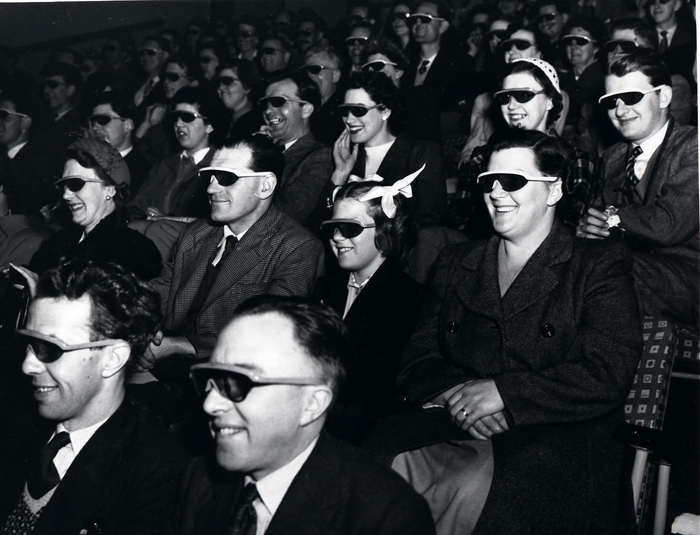 |
| 3-D film screening during the Festival of Britain in London, 1951 |
The remarkable ways in which film was manipulated and used to express different ideas in different ways suggests that the state of video recording technology does not necessarily restrict its usefulness. Rather, it demonstrates that the technology is adapted and utilised for various purposes.
Magnetic Tape
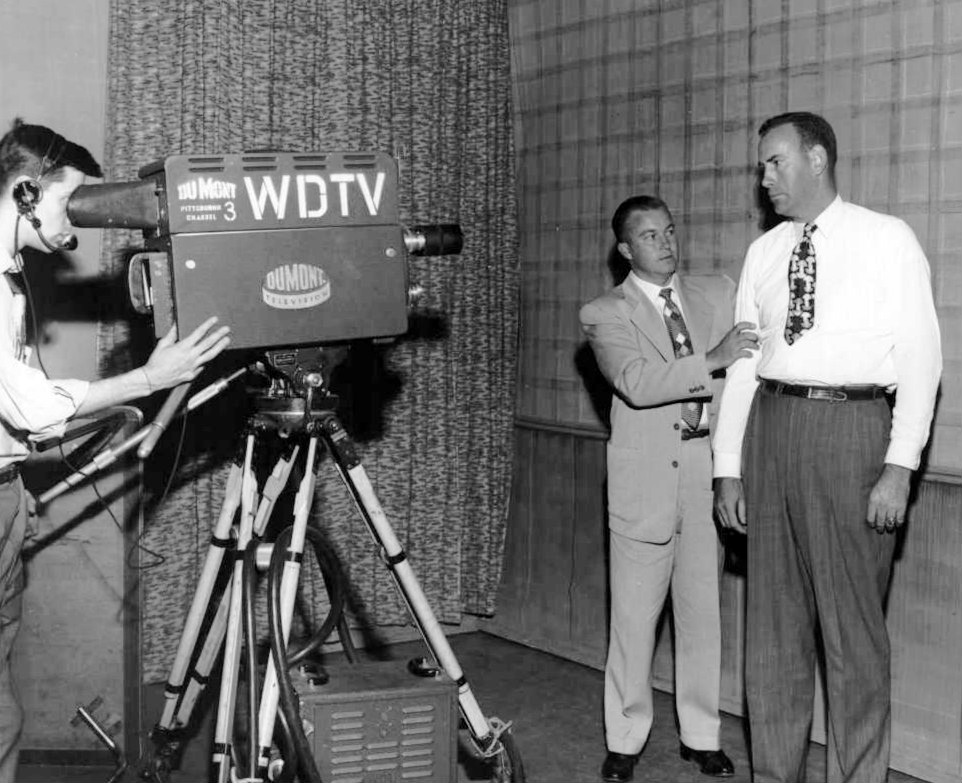 |
| Live broadcast using a kinescope at WDTV |
Although the seemingly insurmountable problem of recording television on film played a significant role in motivating the development of videotape recorders, a problem which had to be resolved because of the time-delay between the East and West Coast of the United States, the trajectory that it took was also defined by pre-existing technology, and social and political circumstances. (See right)
 |
| Poulsen's first Telegraphone, 1899 |
The invention of the magnetic videotape recorder was the result of a combination of contributions.
The magnetic recording technology developed by Valdemar Poulson, who invented the Telegraphone, provided the underlying technology. Poulson’s aim was to simplify telephone communication and improve the poor audio quality of the phonograph. He was himself building on many prior innovations. (See left)
 |
| Magnetophon from a German radio station in WWII |
Magnetic videotape recording technology also owed a great deal to the Magnetophon, a German innovation which America only knew of after World War II. The Magnetophon was in turn, the result of several innovations, one of which was made by a German engineer working on cigarette manufacturing machines. (See right)
Government support and the persistence of the four organisations
The successful development of videotape recording also owed a great deal to the determination of four organisations: Bing Crosby Enterprises, RCA, BBC, and Ampex Corporation; as well as the U.S. government which awarded Crosby Enterprises a $1 million contract in 1951, the first year it opened, to develop videotape recorders for military purposes.
.jpg/330px-Ampex_VR1000A_(serial_329).jpg) |
| AMPEX Quadruplex VR-1000-A, the first commericaly produced video tape recorder, 1961 |
Use of videocassette recorders
The ways in which videocassette recorders were used was not solely technologically determined, nor was it predetermined by demand for home video. It simply offered enticing possibilities that cultural critics leapt on to challenge and critique the moral decadence of television.
Sick of bad television? Make your own home videos!
Portable video recorders
Perhaps one significant change from the film medium, is the enhanced possibilities for portability that videotape offers. Relying on helical-scan technology, portable video recorders were in part, developed in response to military demand, but was also utilised in new ways, by amateurs, to challenge the dominance of TV and Hollywood. It also gave empowered artists against TV and gave birth to new art forms which reflexively critiqued the new video medium. This is a trend that continues into the digital era.
Digital Era
The ubiquity of digital video in the 21st century has perhaps obscured some of the challenges it faced in its initial stages.
Dependency on computer technology
 |
| Mini-computer or video camera? |
Back to basics
Perhaps what is most remarkable about the new digital medium is not its pioneering of new types of motion pictures, but its attempts to reinvent old types.
The 3-D and 4-D technologies of digital video are reminiscent of the 1950s attempts by Natural Vision to impress audiences with a visual spectacle, and an immersive experience. They encounter similar problems like eyestrain, and face challenges from different markets, ranging from the enthusiastic to nonchalant.

The miniaturization that digital video has brought about has also made it possible for people to enjoy videos anywhere. This appeals to the same motivations underlying the motion toys of the 19th century; and are forms of “peep media,” as opposed to public viewing machines, which create an intimate, private experience.
Digital video has also seemed to democratize the production of motion pictures. Amateurs may now record moments of historical importance, while Hollywood’s dominance can now be challenged by independent film makers. Significant as this trend is, it should be considered a continuation of a trend with its roots in magnetic tape recording.
 |
| Peep media: from stereoscopes to iPhones |
Digital video has also seemed to democratize the production of motion pictures. Amateurs may now record moments of historical importance, while Hollywood’s dominance can now be challenged by independent film makers. Significant as this trend is, it should be considered a continuation of a trend with its roots in magnetic tape recording.
Conclusion
As this report has sought to show, the history of video recording technology cannot be understood in terms of a linear development, from primitive to advanced; or from boring to entertaining. The way in which the technology developed was not predetermined by a demand from society for entertainment, or by governments for propaganda. It was the result of a convergence of multiple technologies, a process that was itself subject to political and social circumstances. In this co-constitutive process, both technology and people determine the form of video recording technology that would emerge; and both determine how they would use it. In the final analysis, the remarkable similarities between digital video and earlier forms of motion pictures, forces us to reconsider the claim by the IT and the entertainment industries that higher definition videos, even 3-D or 4-D, will bring deeper meaning to what we watch, or bring greater enjoyment.
References
Dixon, W.W., and G.A. Foster. A Short History of Film. Rutgers University Press, 2008.
Guynn, W.H. The Routledge Companion to Film History. Routledge Companions Series. Routledge, 2011.
Jeff Martin. “The Dawn of Tape: Transmission Device as Preservation Medium.” The Moving Image 5, no. 1 (2005): 45–66.
Judi Hetrick. “Amateur Video Must Not Be Overlooked.” The Moving Image 6, no. 1 (2006): 66–81.
Max Dawson. “Home Video and the ‘TV Problem’: Cultural Critics and Technological Change.” Technology and Culture 48, no. 3 (2007): 524–49.
Meigh-Andrews, C. A History of Video Art: The Development of Form and Function. Bloomsbury Academic, 2006.
Nmungwun, A.F. Video Recording Technology: Its Impact on Media and Home Entertainment. Communication Series. L. Erlbaum Associates, 1989.
Sklar, R. A World History of Film. Harry N. Abrams, Incorporated, 2002.
Thompson, K., and D. Bordwell. Film History: An Introduction. McGraw-Hill Higher Education, 2009.
Subscribe to:
Posts (Atom)